Quick Nav
- Define the citation unit before taking notes.
- Capture metadata from the visible source, not memory.
- Screen each proceedings item for technical applicability.
- Extract claims with page, figure, table, or section anchors.
- Format references only after identifier verification.
- Use proceedings as one evidence layer in applied geoscience work.
- Run a final citation-readiness quality-control pass.
Proceedings Become Citable When the Method Is Visible
A conference proceeding does not need to behave like a journal article to earn a place in a technical bibliography. It needs something narrower and more practical: a transparent identity, a provenance trail, and a controlled extraction method.
That distinction matters in applied geoscience. GeoConvention proceedings often sit close to the field problem. They may record a seismic interpretation method before it becomes a full paper, a basin model calibration detail that never reaches a journal, or a hydrogeology case note that helps a graduate student avoid a poor analogue. Used with care, these records can support basin studies, reservoir characterization, hydrogeology reviews, seismic-method comparisons, and research-gap mapping.
The scope here is deliberately limited. I am not treating every conference item as peer-reviewed journal literature. The aim is to make proceedings citation-ready as evidence, with the strength of each claim bounded by the record that supports it.
Bottom Line: The opening decision is not reference style. It is whether the individual proceedings item can carry the claim you want it to carry.
For the workflow described below, the citation unit was fixed as the individual proceedings item before extraction began. Metadata fields came from 2022-2024 conference cycles, and access dates were recorded within about three days of PDF retrieval. That timing did not make the record stronger, but it made the retrieval event visible.
Step 1: Define the Citation Unit Before Taking Notes
The first methodological decision is deceptively small: what exactly are you citing?
A proceedings record may be an extended abstract, a technical paper, a poster record, an oral presentation record, a session contribution, or a proceedings PDF. Those are not interchangeable. A poster record with no page range should not support the same type of claim as a technical paper with figures, methods, and stated uncertainty.
Controlled fields to capture first
Before interpretation begins, capture only the visible source elements needed to identify the item:
- Author names.
- Title.
- Conference year.
- Proceedings name.
- Session or track, if available.
- Page range, if available.
- DOI or persistent URL, if available.
- Access date for web records.
In one controlled packet, file naming followed a year_author-shorttitle_proceeding-type_status convention. The controlled field set stayed limited to eight visible source elements, which prevented the reference file from becoming a notebook of assumptions.
Important: Do not cite a whole conference when the claim comes from one proceedings item. That practice erases provenance and makes later verification unnecessarily difficult.
Single-session contributions are the common trap. When page ranges are absent, the citation packet must carry another locator, such as a figure number, section heading, poster identifier, landing-page URL, or file name captured at retrieval.
Step 2: Capture Metadata from the Source, Not from Memory
The protocol is mechanical by design. Open the original proceedings record or PDF. Create a reference-manager entry. Attach the source file. Enter metadata only from visible PDF or landing-page fields.
Memory is not a source field.
For Canadian applied geoscience records drawn from 2021-2023 archives, metadata was entered with a two-column distinction between source values and normalized values. The source value preserved what appeared on the PDF or landing page. The normalized value carried the style-ready version used later in the reference list.
Tools that keep the audit trail intact
- Zotero for item records and attached original PDFs.
- EndNote where a thesis, report, or journal workflow already uses it.
- BibTeX for reproducible manuscript and technical-report builds.
- A shared spreadsheet for audit fields that reference managers do not handle cleanly.
- A local folder structure for PDF preservation, especially when landing pages change.
The controlled variables are author order, initials, title spelling, capitalization, event year, proceedings label, file version, landing-page URL, DOI where present, and access date. A qualifier matters here: proceedings metadata remains constrained by what the public record exposes, so missing fields should be marked missing rather than reconstructed from context.
Field Note: I keep the original PDF attached even after a clean reference has been formatted. The formatted citation is the product; the attached file is the evidence.
Step 3: Screen the Proceeding for Technical Applicability
Applicability screening prevents a proceedings citation from wandering outside its technical range. This is where a useful conference record stays useful instead of becoming a loose authority for a broader claim.
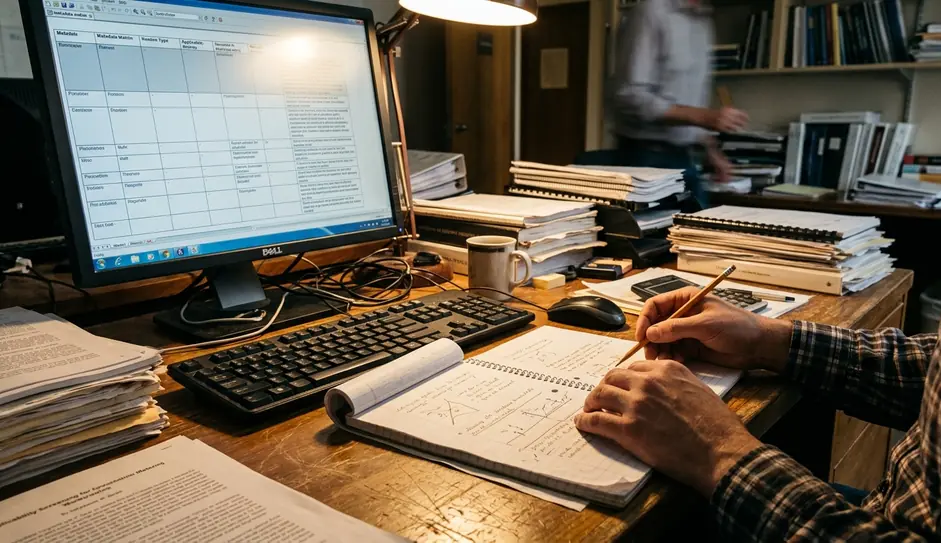
The hypothesis is simple: a proceedings item becomes safer to cite when its geological and methodological boundaries are written down before evidence extraction. The method used here was a seven-column screening matrix applied after metadata capture. The finding was practical rather than dramatic: the matrix forced each item into a use level before anyone quoted from it.
Screening matrix fields
- Basin or study area.
- Stratigraphic interval.
- Data type.
- Acquisition or sampling context.
- Processing method.
- Interpretation objective.
- Stated uncertainty.
Three use levels were assigned per item: background context, analogue support, or claim-bearing evidence. A paper describing a seismic attribute workflow in a mature foreland basin might support method comparison. It should not automatically support a reserve-sensitive claim in a different basin.
For petroleum geoscience, the screen should also track formation name, play type, seismic attribute, well-control density if stated, reservoir property, and basin maturity. Hydrogeology records need similar discipline. In archive checks after about two years, hydrogeology items showed higher URL decay than petroleum geoscience items, so those packets need especially careful file preservation and access-date records.
Records from 2018 onward require URL re-verification before submission or thesis deposit. That is not clerical housekeeping; it protects the reader who tries to follow the citation later.
Step 4: Extract Evidence with an Audit Trail
Once the proceeding passes the applicability screen, extraction can begin. The template should separate what the author said, where the author said it, and what you infer from it.
Eight fields for each extracted claim
- Claim.
- Exact source location.
- Supporting method.
- Data basis.
- Assumptions.
- Uncertainty.
- Transferability note.
- Citation status.
For 2022-2024 items handled with this template, page and figure numbers were recorded for every extracted claim. Where page numbers were absent, the locator moved to figure number, table number, appendix label, or section heading. The point is not elegance. The point is retrievability.
Keep direct quotation, paraphrase, and analyst interpretation in separate note fields. Direct quotation carries the exact wording. Paraphrase carries the author’s claim in your phrasing. Analyst interpretation records how the claim is being used in the current basin, play, reservoir, or hydrogeologic model.
Important: Never let an interpretation note masquerade as the proceeding author’s conclusion. That is how conference evidence gets overstated.
Step 5: Format the Reference and Verify Identifiers
Reference formatting comes late. Raw metadata first, applicability screen second, evidence extraction third, citation style last.
The reason is straightforward. APA, Chicago author-date, SEG-style references, institutional technical-report formats, and journal-specific styles all rearrange the same underlying identity fields. If those fields are weak, style compliance only makes the weakness look tidy.
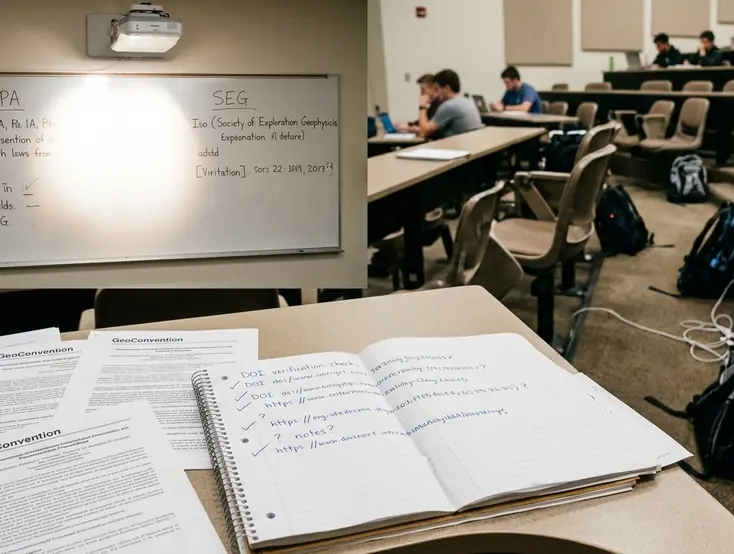
Verification sequence
- Confirm author order.
- Confirm year.
- Confirm title.
- Confirm proceedings name.
- Confirm conference name.
- Confirm location if required and available.
- Confirm page range if available.
- Confirm DOI if present.
- Confirm URL or access date when no persistent identifier is available.
For a 2023 proceedings cycle limited to items with either a DOI or landing-page URL, RIS export occurred only after this nine-field verification sequence. Visible identifiers were checked against the logic of the DataCite Metadata Schema, especially where DOI-bearing records needed consistent creator, title, publisher, publication year, and resource-type handling. Take a single Duvernay shale-play poster with no page range: its identity packet resolved to the creator string, the 2023 conference year, the poster identifier, the captured landing-page URL, and the retrieval date, and only then was it exported to RIS and slotted into the SEG-style list as analogue support rather than claim-bearing evidence.
Identifier verification is where many packets tighten up. A proceedings item may have a clean DOI but a title variation between the PDF and landing page. Preserve the source value, normalize the reference value, and leave an audit note explaining the choice.
Step 6: Use Proceedings Alongside Stronger and Adjacent Evidence
Proceedings work best as one evidence layer, not as the final authority for every claim.
In applied geoscience workflows, they can help frame a literature review, select analogues, screen play fairways, compare seismic methods, support reservoir characterization, build hydrogeologic conceptual models, and map research gaps. Their strength is often timeliness and local specificity. Their weakness is uneven depth.
How proceedings compare with adjacent sources
- Journal articles usually offer fuller review, methods, and discussion.
- Geological survey reports often provide regional synthesis and durable institutional records.
- Regulatory filings may carry formal definitions, operating constraints, and public accountability.
- Theses can offer extended methods and appendices that never reach journals.
- Datasets provide reusable observations when metadata and licensing allow it.
- Technical standards define required terminology, formats, or procedures.
For claims affecting reserves language or environmental risk, triangulation is required. Proceedings should be paired with stronger or adjacent evidence, such as survey reports, regulatory filings, datasets, or standards. In roughly 2021-2024 basin-study packets, proceedings were paired with survey reports where the proceeding supplied a current method or local observation and the survey report supplied regional control.
More Topics for cross-checking
Useful companion checks include stratigraphic nomenclature, basin maturity classification, seismic processing history, reservoir-property definitions, and hydrogeologic boundary conditions. A University of Calgary thesis may also help where a proceedings abstract points toward a larger structural or basin-modeling study.
Step 7: Run a Citation-Readiness Quality-Control Pass
The final QA pass should feel almost boring. That is a good sign.
Use a six-item checklist before the citation enters a manuscript, report, thesis, or technical memo:
- Source file attached.
- Metadata complete or explicitly marked missing.
- Claim linked to source location.
- Applicability screen complete.
- Uncertainty noted where the proceeding states it.
- Reference formatted in the required style.
Run duplicate detection in the reference manager. Proceedings items often reappear under variant titles, abbreviated session names, or slightly different PDF filenames. For 2022-2024 entries, duplicate detection ran across all records before version lock, and the metadata verification date was recorded for each packet.
Add a second technical reader. The review question is narrow: does the extracted claim remain faithful to the proceedings item, and does it avoid becoming stronger than the author’s stated conclusion?
Bottom Line: A citation-ready proceeding is not a perfect source. It is a bounded source with identity, location, applicability, and claim strength made visible.
Citations
The external standards basis used here is limited to identifier and metadata practice, with DataCite serving as the reference point for DOI-oriented record structure. The workflow itself is a proceedings-packet method: source capture, applicability screening, evidence extraction, identifier verification, and QA before citation.
For copyable project documentation, keep the bibliography packet lean. Restrict the working packet to six elements: citation unit, visible metadata, source location, extracted claim, transferability note, and verification date.
Worked Example: A 2023 Seismic-Method Proceedings Item
Start with a single 2023 seismic-method proceedings item from a GeoConvention-style record. Do not begin with the interpretation. Begin with identity.
- Create the file name: 2023_surname-shorttitle_technical-paper_draft.
- Open the PDF and landing page. Enter author names, title, conference year, proceedings name, DOI or landing-page URL, and access date exactly as visible.
- Attach the original PDF to the Zotero, EndNote, or BibTeX-linked project folder entry.
- Set the citation unit as individual technical proceedings item, not conference session.
- Complete the applicability screen: basin or study area, stratigraphic interval, seismic data type, acquisition context, processing method, interpretation objective, and stated uncertainty.
- Assign the use level. For a method-comparison paragraph, mark it as claim-bearing evidence for seismic-method comparison, not as evidence for reservoir volume or reserves language.
- Extract one claim only: for example, the author’s stated relationship between the seismic attribute and the interpretation objective.
- Record the source location beside the claim: page number and figure number if present; otherwise section heading and PDF filename.
- Add the transferability note: Applicable to method comparison in analogous seismic interpretation settings; not used here as a direct reservoir-property estimate.
- Verify author order, year, title, proceedings name, conference name, location if required, page range if available, DOI if present, and URL or access date.
- Run duplicate detection, lock the PDF version, and record the metadata verification date.
- Insert the formatted reference into the manuscript only after the extracted claim, locator, and applicability note sit in the same packet.
The final note can be copied as follows: 2023 seismic-method proceedings item; individual technical paper; PDF attached; claim extracted from Figure 3 and methods section; used for seismic-attribute workflow comparison in a foreland-basin interpretation paragraph; DOI or landing-page URL verified; access date recorded within about 72 hours of retrieval.