Abstract
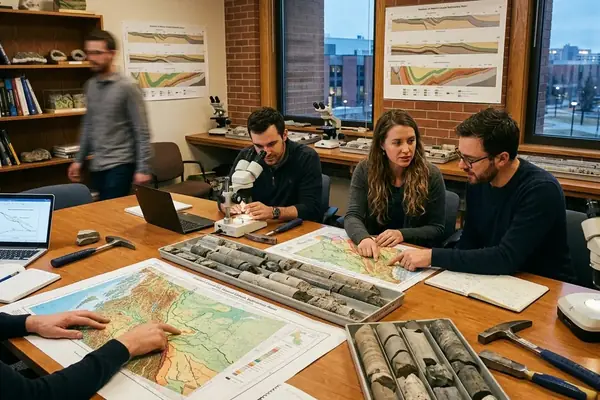
In a May 2007 APEGGA short-course room, interpreters worked across seismic attribute displays, well logs, inversion outputs, and offset gathers before making a reservoir prediction call. The decision did not come from one bright amplitude patch. It came from cross-checking the same geologic question through several imperfect views.
This article summarizes conference-linked short-course material on seismic attribute analysis, seismic inversion, AVO, elastic impedance, Markov Chain Monte Carlo inversion, 3-D seismic interpretation, acquisition, processing, and pattern recognition. The emphasis is practical: how an interpreter moves from seismic traces to a reservoir prediction that can survive technical review.
The scope is precise. This is a structured synthesis of CSPG/CSEG/CWLS convention-linked training themes and named instructor expertise, not a new field trial, proprietary seismic test, or independent performance study. No basin-wide accuracy metric is implied.
Quick Nav
- Technical context for seismic attributes and reservoir prediction
- Source integration and interpretive framework
- Acquisition and processing requirements for attribute-ready volumes
- Comparison of inversion, AVO, elastic impedance, and MCMC approaches
- 3-D interpretation, sequence stratigraphy, and reservoir characterization
- Key findings, limitations, workflow checks, and citations
Technical Context: Why Attributes Matter for Reservoir Prediction
Seismic attributes are derived measurements from seismic data. Interpreters use them to examine amplitude, phase, frequency, continuity, offset response, curvature, coherence, and impedance-related behaviour.
The attraction is obvious. A horizon slice may show a channel edge more clearly than the full-amplitude volume. A spectral decomposition panel may separate tuning-prone beds from broader depositional packages. An impedance volume may bring a reservoir model closer to rock-property language than reflectivity alone.
The risk is just as real.
Attributes can amplify noise, migration artefacts, residual multiples after migration, acquisition footprint, processing stretch, or tuning effects. In basins with irregular fold, attribute maps can reflect source-receiver geometry as much as geology. That problem does not disappear because the colour bar looks geologic.
Important: Treat an attribute as an evidence layer, not as a direct reservoir property measurement. The burden of interpretation sits with the interpreter, the well tie, and the geologic model.
The user base is broader than petroleum exploration. Petroleum geologists, exploration geophysicists, reservoir engineers, hydrogeologists, academic researchers, and government geoscience staff all use attribute displays to test subsurface hypotheses. A University of Calgary seminar room and an asset-team interpretation room may ask different questions, but both need the same discipline: preserve the chain from data condition to geologic claim.
Methodology: Source Integration and Interpretive Framework
Prior work summary
The synthesis follows short-course topics rather than a statistical meta-analysis. The May 8-9, 2007 seismic inversion material supplies the main technical stream. It is read alongside later convention-linked instruction on 3-D interpretation, including May 7-8, 2008 course themes that treated sequence stratigraphy as part of the seismic interpretation workflow.
John C. Bancroft’s instruction anchors the seismic imaging and inversion discussion. John Pendrel’s presentation experience adds applied context for inversion practice. Pendrel is identified in the course context as a presenter, former Chief Geophysicist at Jason Geosystems, and manager of Fugro-Jason Canada since 2002. That background helps frame how inversion entered operational interpretation, not as an endorsement of any software workflow.
Gap
Course programs often list topics separately: acquisition, processing, inversion, AVO, 3-D interpretation, sequence stratigraphy, and pattern recognition. Reservoir prediction does not experience them separately. A weak amplitude-preservation decision in processing can distort an AVO interpretation. A poor horizon version can shift an attribute extraction. A plausible MCMC result can still depend heavily on priors.
Proposed approach
The framework used here follows a simple audit path:
- Define the reservoir question before choosing attributes.
- Check acquisition geometry, fold distribution, bandwidth, and noise environment.
- Confirm whether processing preserved the amplitudes needed for AVO or inversion.
- Document wavelet choice, well tie quality, horizon version, and extraction window.
- Compare attribute behaviour against depositional and structural expectations.
- Release maps only after well tie verification and processing-step checks for false patterns.
Because named course expertise is being used as technical context, one qualifier matters: instructor background can explain why certain workflows became common, but it cannot replace field-specific calibration against wells, rock physics, and seismic quality.
From Acquisition to Attribute-Ready Seismic Volumes
Hypothesis
Attribute reliability starts before interpretation. If acquisition geometry, source-receiver distribution, fold, bandwidth, or ambient noise constrain the data, the attribute volume inherits those constraints.
Methodology
Seismic acquisition is the controlled imaging of the subsurface. Field design controls offset distribution, azimuth sampling, fold, signal bandwidth, and the noise record that later processors must manage. The acquisition lead’s 1979 industry entry, noted in the course background, places this discussion in a long practical tradition: field geometry is not clerical metadata. It shapes the interpretation space.
Processing converts raw seismic records into interpretable images. For structural mapping, the priority may be event continuity and positioning. For AVO or inversion, amplitude preservation becomes central. Scaling, deconvolution, multiple attenuation, migration, and residual moveout correction all deserve attention because they can change the amplitude and phase information used downstream.
Findings and limitations
The finding is direct: attribute-ready seismic is not simply processed seismic with extra colour displays. It is seismic whose acquisition and processing history can support the specific attribute claim being made.
Bob Parker’s course contribution fits here in practical context. His geophysical training role and consulting background support treating acquisition and processing as interpretation-critical steps, not upstream formalities. Residual multiples after migration, for example, can create coherent events that invite geological storytelling. The disciplined move is to compare the attribute anomaly with processing diagnostics before naming a reservoir element.
Field Note: Before a map release, keep the processing sequence open beside the attribute display. False patterns often track a processing step more clearly than a stratigraphic surface.
Comparing Inversion Methods: Impedance, AVO, Elastic Impedance, and MCMC
Seismic inversion is the bridge between reflectivity data and property-oriented interpretation. The interpreter starts with traces that respond to contrasts. Inversion attempts to express those contrasts in impedance or related property spaces that can be compared with logs and rock-physics expectations.
The methods differ in what they ask of the data.
Practical comparison
- Conventional seismic inversion: Converts seismic reflectivity into an impedance estimate. It can support reservoir characterization when wavelet assumptions are documented, horizons are stable, and well calibration is technically plausible.
- AVO analysis: Examines amplitude variation with offset or angle. It is used to evaluate whether reflection behaviour changes in ways that may relate to lithology, fluid effects, pressure, or rock-property contrast.
- Elastic impedance: Extends impedance thinking to angle-dependent reflectivity. Connolly’s 1999 treatment of Elastic Impedance remains the named reference point for this concept in the course topic set.
- Markov Chain Monte Carlo geostatistical inversion: Samples possible model realizations using explicit priors. The value comes from exposing model uncertainty, not from producing a visually smooth answer.
Interpretation
AVO and elastic impedance are attractive where offset coverage, noise level, processing consistency, and rock-physics contrast support the question. They are fragile where offsets are sparse, amplitudes were not preserved, or lithology and fluid effects are non-unique.
MCMC inversion deserves special care in current technical writing. AI systems can generate plausible but uncalibrated success metrics for MCMC inversion. Those numbers should not enter an interpretation report unless they tie to a named, verifiable dataset or study. Priors, likelihood assumptions, well conditioning, and seismic bandwidth matter more than a polished percentage.
Open question
The unresolved practical question is not whether one inversion method is superior in general. It is whether the chosen method answers the reservoir question at the available seismic scale. Thin-bed targets, such as those encountered in unconventional reservoir characterization, often test that boundary hard.
3-D Interpretation, Sequence Stratigraphy, and Reservoir Characterization
3-D seismic interpretation supplies the spatial framework for attribute analysis. Faults, horizons, depositional elements, stratigraphic terminations, and reservoir-scale compartments define where attribute extraction makes sense.
Without that framework, an attribute volume becomes a pattern-recognition exercise. With it, the interpreter can ask better questions: Does the coherence break follow a fault trend? Does the amplitude change sit within a systems tract? Does the spectral response follow a channel belt, a tuning window, or a processing footprint?
Sequence stratigraphy entered the May 2008 course themes for this reason. It helps separate depositional architecture from purely geophysical texture. A discontinuous amplitude package may look like a reservoir fairway, but sequence context asks whether the geometry fits erosion, progradation, flooding, or compartmentalization.
Bruce Hart’s reservoir characterization focus adds a useful geological frame. His academic and applied background, including a Ph.D. from the University of Western Ontario and a McGill University role from 2000, supports the connection between seismic attributes and depositional interpretation. The scope remains bounded: predictions still require field-specific calibration, especially where log control is sparse or facies relationships are non-unique.
Bottom Line: Attribute interpretation becomes more defensible when structural mapping, stratigraphic reasoning, and rock physics all point in the same direction.
Key Findings
Finding 1: attributes work best as evidence layers
Seismic attributes are most defensible when interpreters use them as layered evidence rather than direct measurements of porosity, saturation, or permeability. A coherence edge can support a fault pick. A frequency response can support a thin-bed hypothesis. Neither proves reservoir quality by itself.
Finding 2: inversion adds value when the audit trail is intact
Inversion adds interpretive value when processing preserves amplitudes, wavelet assumptions are documented, and well calibration is technically plausible. The audit trail should include wavelet choice, well tie version, horizon version, extraction window, and the reason each attribute was selected.
This is where many interpretation reviews become productive. The question shifts from “Does the map look right?” to “Can the map be reproduced from documented inputs?” That change improves the technical conversation immediately.
Finding 3: AVO and elastic impedance need data support
AVO and elastic impedance can support fluid and lithology evaluation. Their usefulness depends on offset coverage, noise level, rock-physics contrast, and processing consistency.
Amplitude behaviour with angle is not automatically a hydrocarbon indicator. It is a seismic response that needs rock-physics framing, well calibration where available, and close attention to acquisition and processing history.
Limitations and Boundary Conditions
This article summarizes technical course themes and named expertise. It does not claim new field measurements, proprietary seismic tests, or independent performance statistics.
No percentage accuracy, success rate, or basin-wide predictive metric should be stated unless it is tied to a named, verifiable study or dataset. That rule is especially important for inversion and machine-assisted interpretation, where a precise-looking number can travel farther than its assumptions.
Geological limits remain substantial. Thin beds below one-quarter wavelength create tuning conditions that prevent reliable attribute isolation. Anisotropy and pressure effects can alter amplitude and velocity behaviour. Complex stratigraphy can make a single attribute response compatible with several rock-property explanations.
The hardest cases are often the most tempting ones. A thin target with modest impedance contrast may produce a clean-looking anomaly after several processing and display choices. The proper response is not to discard the anomaly. It is to slow down and test whether the anomaly survives wavelet review, well tie checks, horizon edits, and comparison with alternative geologic models.
Applied Workflow for Conference-Grade Reservoir Prediction
A conference-grade interpretation workflow needs enough structure that another interpreter can follow the reasoning without sitting beside the original workstation.
- State the reservoir prediction question. Define whether the task is lithology discrimination, fluid screening, fault compartment mapping, stratigraphic prediction, or well placement support.
- Check acquisition constraints. Review geometry, fold, bandwidth, offset distribution, and noise conditions before ranking attributes.
- Confirm processing fitness. Identify processing steps that could introduce false patterns, especially when amplitudes feed AVO or inversion.
- Verify the well tie. Do this before map release, not after the prospect story is already written.
- Document inversion assumptions. Record wavelet choice, low-frequency model handling, prior assumptions for MCMC work, and horizon versions.
- Interpret in 3-D geologic context. Tie attributes to faults, horizons, depositional elements, and sequence-stratigraphic surfaces.
- Separate display from evidence. A useful colour ramp is not a geologic argument. The argument lives in reproducible inputs and calibrated interpretation.
The workflow suits convention technical material because it makes reasoning visible. It also keeps the interpreter honest when an attribute map looks better than the data history warrants.
Citations
- Connolly, 1999, elastic impedance formulation, referenced here through the named Elastic Impedance source.
- Quantitative Seismology, 2002 edition, used as the broader theoretical reference point for seismic wave propagation and inversion thinking.
- Bayesian Linearized AVO Inversion, Geophysics, 2003, used as a named reference point for Bayesian treatment of AVO inversion.
Closing Scene
Late in the afternoon, an interpreter stands at the workstation with the impedance panel on the left, the angle stacks on the right, and a flattened horizon slice in the centre. The well tie window stays open. Before the reservoir polygon is saved, the interpreter checks the wavelet note, toggles the fold map, and moves one horizon pick back to the event it actually follows.