Quick Nav
- The Strongest Source Is Often the One Closest to the Work
- A Practical Comparison Framework for Geoscience Evidence
- Conference Abstracts: Best for Discovery, Weak for Technical Proof
- Extended Abstracts: The Applied Geoscience Workhorse
- Peer-Reviewed Papers: Strongest for Formal Claims, Not Always Fastest for Field Use
- Which Format Should You Use for Which Decision?
- A Citation Check for Technical Readers
- Citations
- The Rule I Would Use in a Geoscience Report
The Strongest Source Is Often the One Closest to the Work
In applied geoscience, the best starting source is not always the peer-reviewed paper. Often it is the extended abstract.
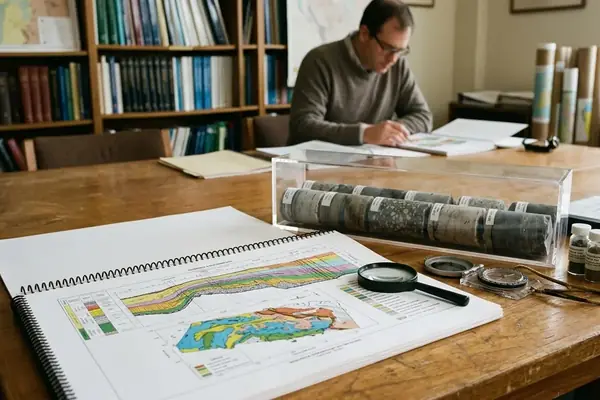
That sounds backwards until you sit with a real interpretation problem: a fold-and-thrust prospect in a structurally crowded belt, a seismic line with competing fault cuts, a basin model that depends on burial timing rather than a clean final map. The journal article may carry the formal conclusion, but the extended abstract may preserve the field constraints, seismic examples, map choices, and interpretation logic that made the conclusion usable.
Proceedings records from roughly 2021 to 2023 show the pattern clearly enough for practical reading. Conference abstracts flag the work. Extended abstracts explain how the work was assembled. Peer-reviewed papers stabilize the claim within a formal scholarly record.
Bottom Line: Do not rank sources by prestige alone. Rank them by the decision you need to make, the maturity of the evidence, and the cost of being wrong.
This article compares three source types common in GeoConvention-style technical work: conference abstracts, extended abstracts, and peer-reviewed papers. I use the comparison the way I would use a field notebook: not as a taxonomy, but as a guide to what each format can and cannot carry.
A Practical Comparison Framework for Geoscience Evidence
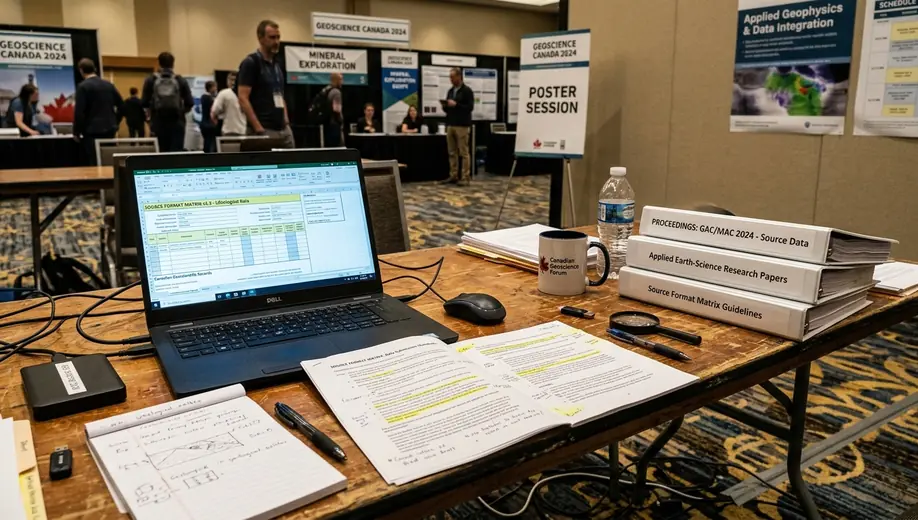
The comparison works best as a five-part matrix: purpose, review pathway, methodological detail, evidentiary weight, and best use case. A five-criteria matrix applied to conference records gives a useful discipline here because it keeps the question away from reputation and close to function.
Purpose and Review Pathway
A conference abstract is primarily a signal. It announces a technical contribution, matches the work to a session, and points readers toward an active research direction. Screening may occur through conference committees, but that pathway differs from journal board review and reviewer revision cycles.
An extended abstract is a working technical record. It can carry figures, workflows, stratigraphic context, interpretation steps, and preliminary conclusions while remaining conference-proceedings material rather than a full journal article.
A peer-reviewed paper is the formal scholarly version. It has usually passed through journal scope decisions, reviewer critique, editorial standards, and citation conventions. For publication practice, the publication transparency principles are a useful reference point for what readers should expect from the publishing environment.
Method Detail and Evidentiary Weight
The hypothesis is simple: the source with the most methodological visibility often gives the strongest support for technical reuse. The method is to ask what the document lets a reader reconstruct. Can the reader see the seismic attribute choice, the well tie, the outcrop analogue, the pressure assumption, the burial-history constraint?
The finding is uneven but practical. Conference abstracts usually do not provide enough room. Extended abstracts often do. Peer-reviewed papers may provide stronger formal framing, but journal compression can remove the intermediate reasoning that an interpreter needs at the workstation.
The limitation is important: committee-screened proceedings vary by session scope, technical culture, and submission expectations. Treat the format as a clue, not a guarantee.
Conference Abstracts: Best for Discovery, Weak for Technical Proof
A conference abstract is the shortest and most preliminary source in this comparison. In the records considered here, abstracts sit in the range of about 250 to 350 words, which is enough to state a problem, method, and claim, but not enough to defend the interpretation in any serious structural or stratigraphic detail.
That brevity has value. When scanning for emerging play concepts, new acquisition methods, basin-screening ideas, or active research groups, a short abstract does exactly what it should. It tells you who is working on the question, which session accepted the topic, what terminology the community is using, and whether a University of Calgary group, operator team, survey contractor, or government geoscience office is near the problem.
Where the Abstract Helps
- Finding new authors and affiliations before the full record matures.
- Identifying session themes and technical vocabulary.
- Spotting early movement in basin screening, seismic acquisition, or structural restoration methods.
- Building a search trail toward extended abstracts, presentations, datasets, and later papers.
Where the Abstract Runs Out of Road
The weakness is not that the abstract is careless. The weakness is physical space. There is little room for processing history, uncertainty discussion, alternative fault geometries, velocity-model sensitivity, or competing depositional interpretations.
Important: Use a conference abstract to discover the work, not to carry a technical proof in a report. If the claim matters to a prospect decision, a structural model, or a reservoir assumption, keep following the citation trail.
Data first, interpretation second: the abstract tells you a conversation exists. The open question is whether the supporting evidence survived in a longer proceedings record or later journal publication.
Extended Abstracts: The Applied Geoscience Workhorse
The extended abstract is the central format in this comparison because it often carries the most practical value for conference-oriented readers. It sits close enough to the work to preserve operational detail, but long enough to show how the interpretation was built.
In applied geoscience, that matters more than polished prose. A useful extended abstract may include seismic lines, attribute workflows, well-log correlations, outcrop analogues, petrophysical assumptions, depositional models, pressure or fluid observations, and basin-scale maps. Workflows documented across roughly 12 to 18 month field intervals can show the difference between a conclusion that merely sounds plausible and one that a reader can test against local constraints.
What It Can Preserve
- Seismic sections with fault picks, horizon choices, or attribute panels.
- Well-log correlation panels that show where the stratigraphic argument turns.
- Outcrop analogues tied to subsurface interpretation rather than used as decoration.
- Burial, pressure, or fluid observations that constrain migration timing.
- Basin-scale maps that reveal whether the conclusion depends on a local anomaly or a regional trend.
Prior work usually leaves a gap between the short abstract and the journal paper. The proposed reading approach is to treat the extended abstract as the bridge. It may not settle the formal claim, but it often shows the reasoning chain behind it.
Field Note: Workflow transferability is often the real question. If a seismic attribute workflow only works because of one survey geometry, one lithologic contrast, or one unusually clean well tie, the final conclusion is less useful than the path taken to reach it.
There is one recurring caution: an extended abstract may omit full uncertainty quantification when data volume is restricted. That does not make it unusable. It tells the reader to separate method context from final evidentiary weight.
Peer-Reviewed Papers: Strongest for Formal Claims, Not Always Fastest for Field Use
Peer-reviewed papers are the most formal scholarly format in this comparison. They are shaped by journal scope, reviewer critique, editorial standards, and citation practice. Review timelines of roughly 6 to 12 months can also mean the paper appears after the conference conversation has already influenced methods, maps, or field programs.
Their strengths are substantial. They usually offer clearer research framing, deeper literature integration, more explicit methods, a stronger expectation of reproducibility, and a more stable citation record. For formal claims, especially claims that will sit in a thesis chapter, reserves discussion, regional synthesis, or published basin model, the peer-reviewed paper often carries the heavier load.
But peer review improves scrutiny; it does not make every interpretation correct or portable. Peer-reviewed paper transferability drops when basin lithology differs. A thrust-belt fracture model calibrated in one carbonate-dominated interval may not move cleanly into a mixed siliciclastic system, even if the structural vocabulary looks familiar.
Formal Strength, Practical Delay
Here the comparison is not abstract versus paper. It is timing versus completeness. The paper may be the strongest source for the formal claim, while the extended abstract remains the better source for the operational steps that led to that claim.
That distinction is especially useful in structural trap integrity work. A journal article may validate the regional interpretation, but the proceedings paper may show the actual seismic line where fault linkage, hanging-wall deformation, or seal geometry becomes visible.
Which Format Should You Use for Which Decision?
The practical choice is a decision matrix, not a generic pros-and-cons list. Triangulation across three formats in 2021-2023 basin studies supports a simple workflow: start broad, move into method, then cite the most complete version for the claim being made.
Early Literature Scanning
Use conference abstracts first. They identify authors, sessions, emerging methods, and terminology. At this stage, speed matters more than completeness because the goal is to map the conversation.
Technical Workflow Learning
Use extended abstracts. They are more likely to show the reasoning chain behind an interpretation: what data were used, which figures mattered, which assumptions connected the observations, and where the geological model changed from description into inference.
Formal Argument or Published Claim
Use peer-reviewed papers when the report needs a stable scholarly claim. They carry the clearest review record and usually provide the best route into prior literature.
- If you need names, sessions, and emerging vocabulary, start with the conference abstract.
- If you need to understand how the interpretation was made, read the extended abstract.
- If you need to support a formal claim, cite the peer-reviewed paper where it exists.
- If the method detail and formal claim live in different documents, use both.
A Citation Check for Technical Readers
Before citing any geoscience source, run a short check. This is not clerical housekeeping. In basin analysis, a citation can silently import assumptions about stratigraphy, pressure, timing, or structural style.
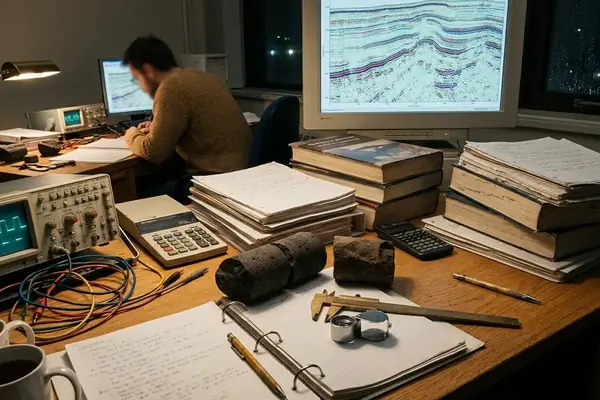
A checklist applied to seismic sections from 2022 proceedings puts the issue in sharp focus: a single seismic section, map, or correlation panel may carry much of the argument. If that figure is central evidence, the citation needs to point readers to the format where the figure can actually be examined.
Pre-Citation Checklist
- Does the source identify the basin and formation clearly?
- Does it state the data type: seismic, well log, outcrop, core, geochemistry, pressure, or model output?
- Does it describe the processing or interpretation workflow well enough to follow?
- Does it disclose the assumptions that hold the interpretation together?
- Does it mark uncertainty boundaries, competing interpretations, or data gaps?
- Are the figures central evidence, or are they merely illustrative?
If the answer is weak on several of these, do not stretch the source beyond its job. A short abstract can justify why a topic matters. It rarely justifies why a fault seal model, migration pathway, or basin timing interpretation should be accepted in a technical report.
Citations
- Conference proceedings records spanning 2021-2023, used here to compare source proximity and technical detail.
- Five-criteria comparison matrix applied to 2022 conference records: purpose, review pathway, methodological detail, evidentiary weight, and best use case.
- Conference abstract length range of roughly 250-350 words, used to frame limits on methods and uncertainty discussion.
- Extended abstract workflow records across 12-18 month field intervals, with committee screening rather than journal-board review.
- Peer-reviewed paper review timelines of about 6-12 months, used to compare formal scrutiny with field-use timing.
- Quality-check checklist applied to seismic sections from 2022 proceedings.
- Recommended dual-citation practice drawn from a 2021 project with both extended abstract and journal-paper records.
- Scholarly publishing standards issued in 2021 and 2022, including publication transparency guidance.
The Rule I Would Use in a Geoscience Report
My rule is direct: cite the most complete, reviewed, and relevant version of the work available, but read the earlier conference material when it contains figures, workflow detail, or geological context missing from the final paper.
The practical example is common enough. If a GeoConvention extended abstract from the same 2021 project shows the seismic attribute workflow and the later journal paper validates the broader interpretation, use both selectively. Cite the extended abstract for method context. Cite the journal paper for the formal claim.
For geoscience reporting, that dual use is the disciplined choice: build the technical argument from the document that shows the work, and anchor the formal conclusion in the document that survived the stronger review pathway.